2053 Woodbridge Avenue - Edison, NJ 08817

Friday, April 17, 2026

E747 VercammenLaw News


E747 VercammenLaw News

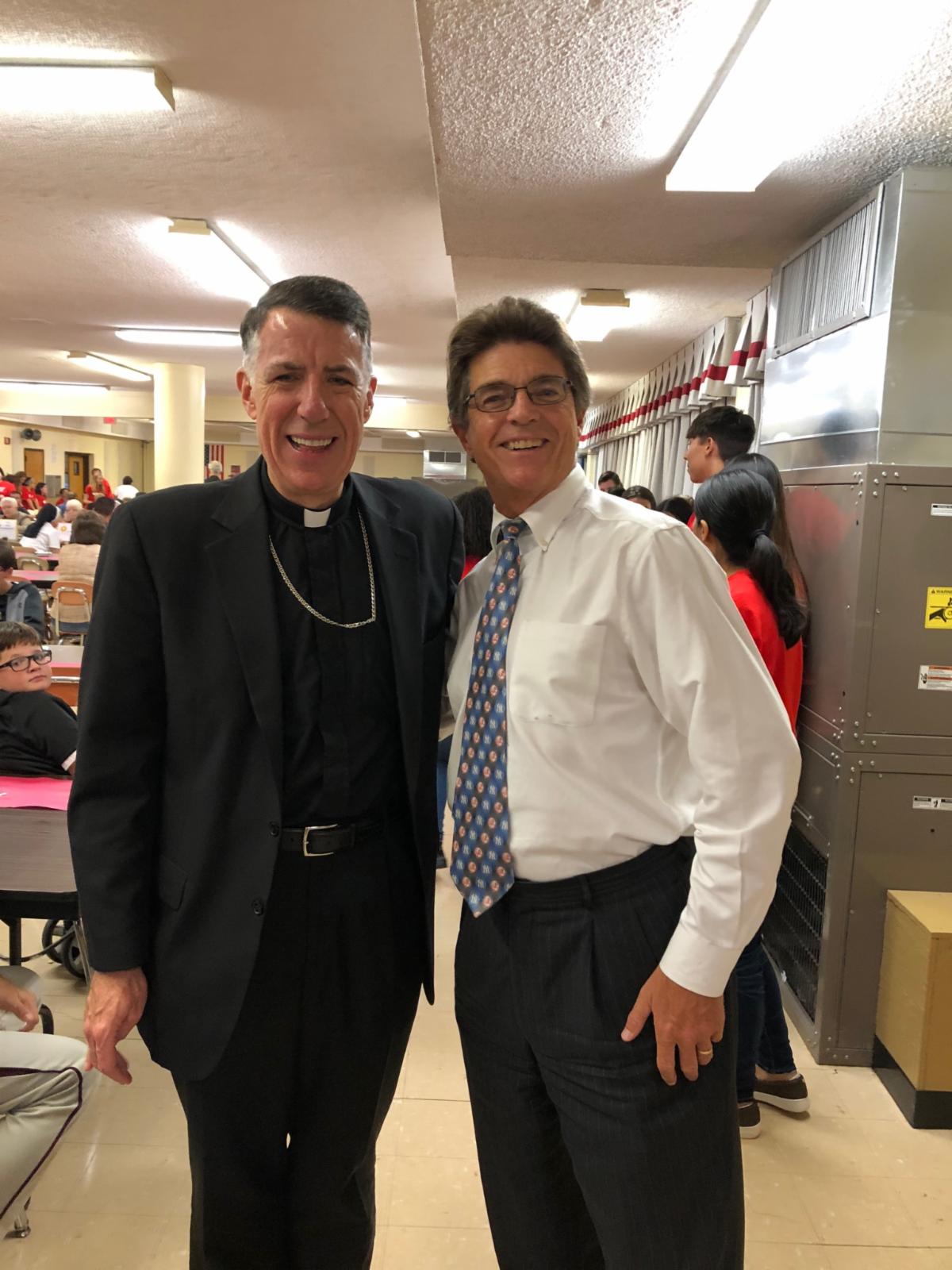
1 Bishop James Francis Checchio and Kenneth Vercammen at  St. Thomas Aquinas High School

 2 Arrested at a St. Patrick’s Parade in NJ?

3 2026 nominations for its annual NJSBA “Municipal Court Practice Award”.

4 Domestic violence law PDVA was amended to include coercive control among the statutory factors courts must consider when determining whether to issue an FRO

5 Third Cell phone violation includes possible 90-day loss of license

1 Bishop James Francis Checchio and Kenneth Vercammen at  St. Thomas Aquinas High School Edison charity event.


Bishop Checchio and Ken Vercammen both attended the University of Scranton.

    He previously served as Bishop of Metuchen from 2016 to 2025 and was promoted to serve as Archbishop of the Archdiocese of New Orleans.

 2 Arrested at a St. Patrick’s Parade in NJ?

Sometimes a good time gets excessive.

Penalties if arrested 

   Over 100 police and law enforcement will be out at parades to charge persons for drunk & disorderly matters.

 Disorderly person criminal offenses- ex Simple Assault, shoplifting & cases in Municipal Court

 Jail 2C: 43- 8      jail  6-month maximum max

                         probation 1-2 year                                    

                         community service  180 days maximum  

                       mandatory costs, VCCB and other penalties

Disorderly- fines:     2C: 43- 3     $1,000 Fine  maximum        

There are dozens of other penalties a court can impose, depending on the type of matter.   


More info at https://www.blogger.com/blog/post/edit/6420448491658025618/2354841753249276313


2C:12-1. Assault. a. Simple assault. A person is guilty of assault if he:

(1)Attempts to cause or purposely, knowingly or recklessly causes bodily injury to another; or

(2)Negligently causes bodily injury to another with a deadly weapon; or

(3)Attempts by physical menace to put another in fear of imminent serious bodily injury.

•     Simple assault is a disorderly persons offense unless committed in a fight or scuffle entered into by mutual consent, in which case it is a petty disorderly persons offense.

      Resisting Arrest

It is a criminal offense in the State of New Jersey (2C: 29-2) for a person to purposely prevent a law enforcement officer from effecting a lawful arrest. Often a crime of the fourth degree.

    Indictable Crime Penalties    [Felony type]  [ Superior Court]

•        Jail  potential          Fine max                 Probation

•        1st degree             10- 20 years       $200,000 [presumption of jail]

•     2nd degree                         5-10 years   $150,000 [presumption of jail]

•     3rd degree                         3- 5 years    $15,000   1 year- 5 year

•     4th degree                         0- 18 months       $10,000   1 year- 5 year

Hindering Apprehension or Prosecution (2C:29-3)

A person commits an offense if with purpose to hinder the detention, apprehension, investigation, prosecution, conviction, or punishment of another for any crime or motor vehicle violation.

•     Depending on the circumstances, a crime of the third degree, fourth degree, or a disorderly persons offense.


Disorderly conduct 2C:33-2. a. Improper behavior. A person is guilty of a petty disorderly persons offense, if with purpose to cause public inconvenience, annoyance or alarm, or recklessly creating a risk thereof he

(1)   Engages in fighting or threatening, or in violent or tumultuous behavior; or

(2)   Creates a hazardous or physically dangerous condition by any act, which serves no legitimate purpose of the actor.

b. Offensive language. A person is guilty of a petty disorderly persons offense if, in a public place, and with purpose to offend the sensibilities of a hearer or in reckless disregard of the probability of so doing, he addresses unreasonably loud and offensively coarse or abusive language, given the circumstances of the person present and the setting of the utterance, to any person present.

“Public” means affecting or likely to affect persons in a place to which the public or a substantial group has access; among the places included are highways, transport facilities, schools, prisons, apartment houses, places of business or amusement, or any neighborhood.

·      Petty Disorderly person - 30 days jail   maximum

Petty DP $500 max Fine, VCCB and other penalties

Sometimes an experienced attorney can negotiate with the prosecutor to have the charges reduced to a Municipal Ordinance. Other times for first offenders we can make a motion for the first offenders program, Conditional dismissal. 


         2C:33-15 Possession, consumption of alcoholic beverages by persons under legal age; penalty

Jail 2C: 43- 8          potential jail  6 month maximum 

             probation 1-2 year max                                                  

             community service  180 days maximum  


Disorderly- fines:    $500- $1,000 Fine  maximum  under 2C: 43- 3

         plus mandatory costs, VCCO and other penalties     

  33:1-81 Underage drinking and Misrepresenting age to induce sale or delivery to minor

fine 500-1,000, court costs and other penalties

If charged with any criminal offense, immediately schedule an appointment with a criminal trial attorney. Don’t rely on a real estate attorney, public defender or a family member who took a law class in school. When your life and career is on the line, hire the best attorney available.

      Kenneth Vercammen’s Law Office represents people charged with criminal and Municipal Court offenses. We provide representation throughout New Jersey. Criminal charges can cost you.  If convicted, you can face high fines, jail, Probation  and other penalties.  Don’t give up!  Our Law Office can provide experienced attorney representation for criminal violations. We also help represent persons who are injured at bars and restaurants.

3  Nominations for its annual NJSBA “Municipal Court Practice Award” 2026

Nominations may be of a New Jersey lawyer, prosecutor or retired judge, in good standing, who has evidenced:

1.      Public service in advancing the development of municipal court practice in New Jersey in the preceding year or cumulatively as lifetime achievements in the field. 

2.      Dedication to the positive development of municipal court practice by publishing, teaching, and serving on municipal court practice committees.

 3.     Commitment to significant and sustained pro bono representation or pro bono service in order to positively affect the administration of justice in municipal courts

4.      Leadership in municipal court practice activities on a state, county and local bar association level.

    Nominations must be in writing and include both your and nominee’s name, address, phone, fax, and email address, along with detailed reasons in support of the nomination. Nominations are confidential and may be sent by mail, fax, or email, which must be received no later than 9am on April 15, 2026 to any of the following members,  Although the AOC does not permit an active Judge or court employee to receive the award, such nominations are not prohibited. 

No nomination goes without formal recognition by the NJ State Bar Assoc.

Submit to njsbamunicipalcourtaward@gmail.com

Questions Joshua Reinitz, Past Chair, Mun. Ct. Practice Section joshreinitz@gmail.com

Ken Vercammen, Past Chair, Mun. Ct. Practice Section 

Kenv@njlaws.com

Albert J Mrozik, Past Chair, NJSBA Mun. Ct. Practice Section mrozika@icloud.com

Connie Bentley McGhee Esq.

talk2connieesq@gmail.com

  If you have no email: fax to Kenneth Vercammen, Esq. 2053 Woodbridge Ave. Edison, NJ 08817  Fax: 732-572-0030

4 Domestic violence law PDVA was amended to include coercive control among the statutory factors courts must consider when determining whether to issue an FRO.  S.M.T. VS. S.A.

  The parties appealed from their respective denials of final restraining orders (FROs) against each other. S.M.T. alleged a series of incidents regarding physical abuse, forced sexual acts, and coercive control within the parties' marriage. Although the trial court concluded S.A. committed the predicate act of simple assault and recognized a prior incident of simple assault against S.M.T., it did not make specific findings with respect to the sexual assault allegations or coercive control and ultimately denied S.M.T. an FRO. It reasoned the proven incidents of physical assault amounted to "marital contretemps" for which an FRO was not necessary to protect S.M.T. from future harm because any risk could be handled in the existing family dissolution matter. The court disagreed and concluded S.M.T. proved the need for an FRO because she proved simple assault, sexual assault, coercive control, and established the likelihood of a risk of continued domestic violence. A pending dissolution matter is not the appropriate forum to address future risk of domestic violence, unless the parties have mutually agreed to civil restraints. 

   The court concluded if the predicate act involves physical force and violence, "the risk of harm is so great that the inquiry [regarding the secondary analysis of Silver v. Silver] can be perfunctory."  J.D., 207 N.J. at 488. In these cases, "the decision to issue an FRO 'is most often . . . self-evident.'"  A.M.C. v. P.B., 447 N.J. Super. 402, 417 (App. Div. 2016) (quoting Silver, 387 N.J. at 127). It would be rare for proven physical assault to be deemed mere marital contretemps, and the court found no reported decision where marital contretemps was relied upon as a basis for denying a restraining order where physical assault was a proven predicate act. 

   Additionally, effective January 8, 2024, the PDVA was amended to include coercive control among the statutory factors courts must consider when determining whether to issue an FRO. N.J.S.A. 2C:25-29(a)(7). (“Any pattern of coercive control against a person that in purpose or effect unreasonably interferes with, threatens, or exploits a person's liberty, freedom, bodily integrity, or human rights with the court specifically considering evidence of the need for protection from immediate danger or the prevention of further abuse.”) Coercive control is not among the predicate acts enumerated in the PDVA; rather, it is analyzed pursuant to the second prong of Silver.

   The trial court failed to make findings regarding the allegations of coercive control in its analysis of prong two. S.M.T. detailed S.A.'s acts of coercive control in limiting her travel, controlling the family's finances and her access to money, surveillance by various electronic means, and depriving her of sleep using lights, television noise, and spilling water on her. 

   The trial court stated: "It's clear from the contentions that it's somehow recognized by [S.M.T.] that [S.A.] feels he has a right to exert certain authority over her, and again, the [trial court doesn't pretend to understand the actual tenets of the faith or culture in that regard." The court noted actual tenets of faith and culture are not relevant as to whether acts of physical assault, sexual abuse, or coercive control have occurred. Docket A-0973-24

Full opinion at Criminal Law- Recent Cases Vercammen Law

https://njcriminallaw.blogspot.com/2026/02/pdva-was-amended-to-include-coercive.html

5 Third Cell phone violation includes possible 90-day loss of license

    The fines for talking or texting on a hand-held wireless communications device were increased. More details at http://www.njlaws.com/39_4-97_3cellphone.htm


     It is usually no cost effective to hire a trial attorney for $1,000 for a first offense cell violation. It is recommended for a 2nd offense or more.


39:4-97.3 d.A person who violates this section shall be fined as follows:


(1)for a first offense, not less than $200 or more than $400 plus court costs and possible court appearance; [no points] 


(2)for a second offense, not less than $400 or more than $600 plus court costs and possible court appearance; [no points]   


(3)for a third or subsequent offense, not less than $600 or more than $800 plus court costs . [Court appearance mandatory][3 points]


For a third or subsequent violation, the court, in its discretion, may order the person to forfeit the right to operate a motor vehicle over the highways of this State for a period of 90 days. In addition, a person convicted of a third or subsequent violation shall be assessed three motor vehicle penalty points pursuant to section 1 of P.L.1982, c.43 (C.39:5-30.5).